

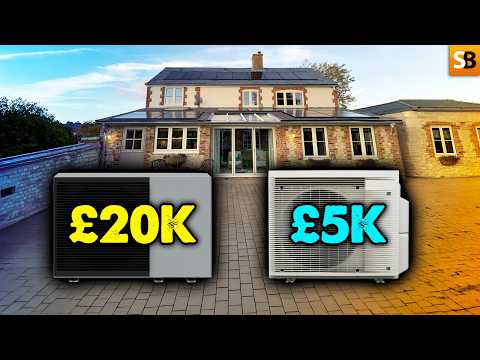
// Walking through the air-to-air units and the Sunamp heat battery, filmed for Skill Builder. Watch on YouTube ↗
// The setup at a glance
Heating/cooling: Daikin multi-split air-to-air — one 3MXM52A9 outdoor unit feeding three Stylish (FTXA) wall units in the main living areas (2.0kW bedroom, 2.5kW lounge, 3.5kW garden room). £5,300, zero VAT (ESM relief), Nov 2025.
Hot water: Sunamp Thermino 300e heat battery (~12kWh / ~300L-equivalent), £4,774 inc VAT, replacing a failed hot-water cylinder, Feb 2026.
Combined spend: ~£10,074 for heating/cooling the main rooms plus all hot water.
I heated and cooled my home with a £5,300 air-to-air heat pump plus a £4,774 Sunamp heat battery for hot water — about £10,000 all-in, against the £27,000 quote I was given for a conventional air-to-water system. The catch: air-to-air doesn't qualify for the £7,500 grant.
Why I didn't fit the "normal" heat pump
When people say "heat pump" in the UK they almost always mean air-to-water — a unit that heats water and pushes it round radiators or underfloor pipes, with a big hot-water cylinder for your taps. It's the system the £7,500 grant is built around, and for a lot of homes it's the right call.
I went a different way: an air-to-air heat pump heating the three main living areas, and a Sunamp heat battery for hot water. No wet central heating circuit, no traditional cylinder. To be straight with you up front — this isn't a whole-house wet system that heats every room off one boiler; it's targeted heating and cooling in the rooms I actually live in, plus a compact heat battery doing all the hot water. People find this surprising, so let me explain why it can make sense — and, because this is Decarbonarma, exactly where the catch is.
Air-to-air: the heat pump people forget exists
An air-to-air heat pump is, mechanically, very close to an air-conditioning unit — it moves heat between the outside air and the air inside your rooms via wall or ceiling units. The upsides are real:
- It's efficient. Done well, A2A can match or beat air-to-water on raw efficiency because it skips the losses of heating water and pushing it round a circuit.
- It does cooling too. The same units cool in summer — something a standard air-to-water system simply can't do. In a warming climate that's not a gimmick.
- It's cheaper and less disruptive to fit. My whole three-room Daikin system — one outdoor unit, three indoor heads, all pipework and commissioning — came to £5,300, with zero VAT under the Energy Saving Materials relief. No radiators to upsize, no wet pipework, no big cylinder. Compare that to a typical air-to-water install at £10,000–£14,000 before the grant.
- Room-by-room control. You heat the rooms you're using, when you're using them.
The honest trade-offs: it heats air, not water, so it can feel different to a radiator's gentle background warmth; the indoor units are visible on the wall; and it does nothing for your hot water — which is exactly where the Sunamp comes in.
Sunamp: hot water without the cylinder
Full honesty: the Sunamp wasn't a carefully planned green upgrade — it was a distress buy. My hot-water cylinder finally gave up after 20 years, choked with limescale from two decades of hard water. When your cylinder fails you need hot water back fast, so this was a forced decision under time pressure — and I'd rather tell you that than pretend it was all part of a master plan.
A Sunamp Thermino is a heat battery. Instead of storing hot water in a big insulated tank, it stores heat in a salt-based phase-change material, then heats your mains water instantly as it passes through, at full mains pressure. Why I went for it over a like-for-like new cylinder:
- It's tiny — up to four times smaller than the equivalent hot-water cylinder, which matters when you've not got an airing cupboard to spare.
- Far lower standing losses — roughly 0.77 kWh lost over 24 hours versus about 1.42 kWh for a typical cylinder.
- No legionella risk and no annual maintenance — there's barely any stored water to harbour bacteria.
- It loves a smart tariff — you charge it on cheap off-peak electricity overnight, then draw hot water all day from stored heat.
Mine cost £4,774 including VAT — a Thermino 300e supplied, installed and commissioned, with the old cylinder removed and taken away. (Worth noting: unlike the air-to-air units, this was charged at the standard 20% VAT, not zero-rated — about £796 of the total — so check the VAT treatment on any quote you get.)
A word on hard water, since that's what killed my last cylinder. A heat battery isn't a magic limescale cure — your incoming mains water still passes through a heat exchanger, so scale management still matters. Sunamp take this seriously: they insist on an electronic limescale preventer being fitted as part of the install, precisely to protect the heat exchanger. Mine has one. So the failure mode is genuinely different from my old cylinder — no big tank sitting and scaling for 20 years, plus active scale prevention on the way in. In a hard-water area, treat that inline protection as non-negotiable.
The catch nobody mentions: the grant
Here's the bit the brochures skip, and the bit that makes this article honest and useful. The £7,500 Boiler Upgrade Scheme is for air-to-water and ground-source heat pumps. A standalone air-to-air system does not qualify for the big grant — that's the single biggest reason A2A stays niche in the UK despite its efficiency.
What I did get was the 0% VAT under the Energy Saving Materials relief — so my £5,300 was £5,300, with no 20% on top. That's a real saving (worth roughly £1,000 here), just nothing like the headline £7,500 an air-to-water system attracts.
So the comparison isn't just "which is more efficient" — it's "is A2A's lower install cost enough to beat air-to-water after air-to-water's £7,500 head start?" And here I can give you a real number for my own house, not a brochure range.
// The air-to-water quote I actually got
I had a Heat Geek installer come out and survey the house properly for a conventional air-to-water heat pump. The proposal came back at £27,000 before grant — so roughly £19,500 after the £7,500 Boiler Upgrade Scheme. My air-to-air units plus the Sunamp came to about £10,000 all-in. For my house, the "grant-backed" option was still nearly double the price.
That's the honest, specific version of the trade-off. The generic figures say air-to-water lands around £3,000–£7,000 net after the grant — but those are easy houses. Mine clearly wasn't: a full wet system with the radiator and pipework upgrades it needed pushed the real quote to £27k. The catch, to be fair, is that the two systems aren't doing the same job. The air-to-water proposal would heat every room off radiators plus do the hot water; my A2A heats and cools the three main living areas — the rooms I actually spend time in — and the Sunamp handles hot water separately. If your priority is even heat in every room off one system, air-to-water is still your answer. But if it's efficient, controllable comfort where it counts (plus summer cooling) without a £20k bill, this is a genuinely overlooked route.
Who should actually consider this
Be honest with yourself. This setup suits you if:
- Your home is well-insulated and not huge — A2A shines when heat demand is modest.
- You want cooling in summer, not just heating.
- You're short on space for a big cylinder, or doing a retrofit where wet pipework is a pain.
- You're happy to run a smart tariff and charge the Sunamp off-peak.
- You can live with wall-mounted indoor units and air-based heat.
It's probably not for you if you've got a big, leaky house needing serious heat, you want the £7,500 grant to do the heavy lifting, or you specifically want radiator-style background warmth. In those cases air-to-water is likely the better call.
The one-line version
Air-to-air plus a Sunamp is the heat-pump setup the UK mostly ignores — efficient, space-saving, does cooling, and great on a smart tariff — but you trade away the £7,500 grant, so it wins for the right home and loses for the wrong one. Mine was the right home.